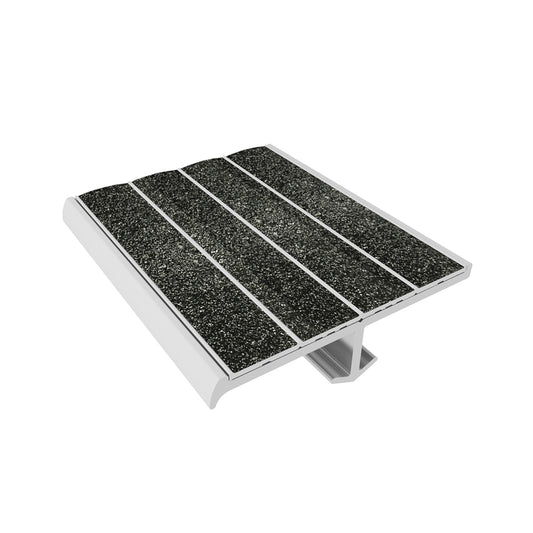
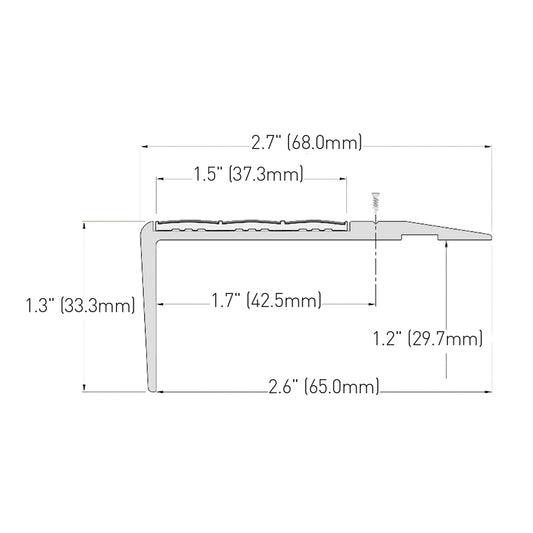
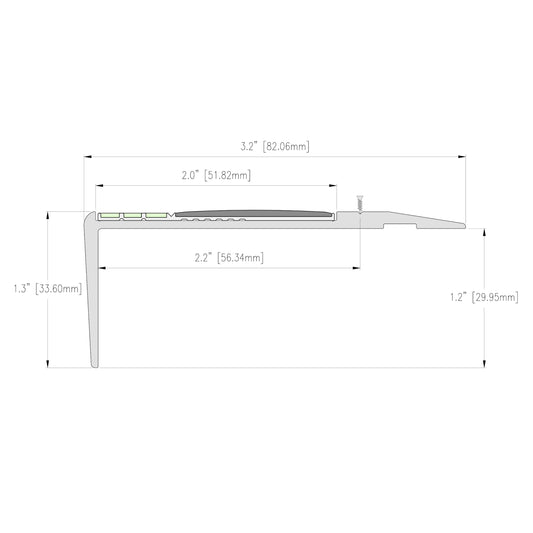
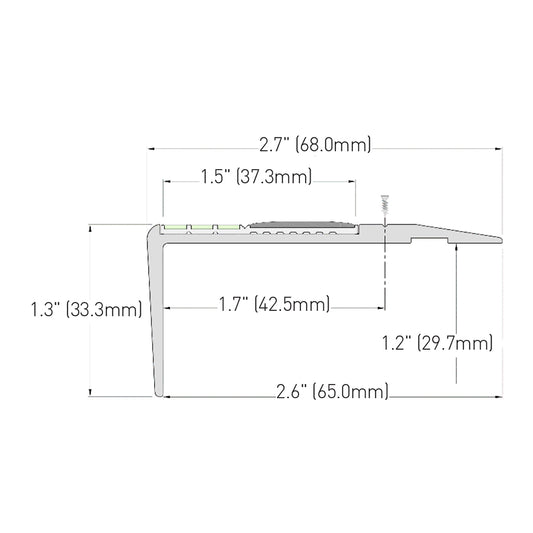
What is a photoluminescent stair nosing?
A photoluminescent stair nosing is a stair-edge profile that
combines visible step-edge definition with light-storing
photoluminescent material. Ecoglo® luminous stair nosings also
incorporate hard-wearing non-slip material to provide traction
at the leading edge of the step.
What is the difference between a luminous stair nosing and a photoluminescent contrast strip?
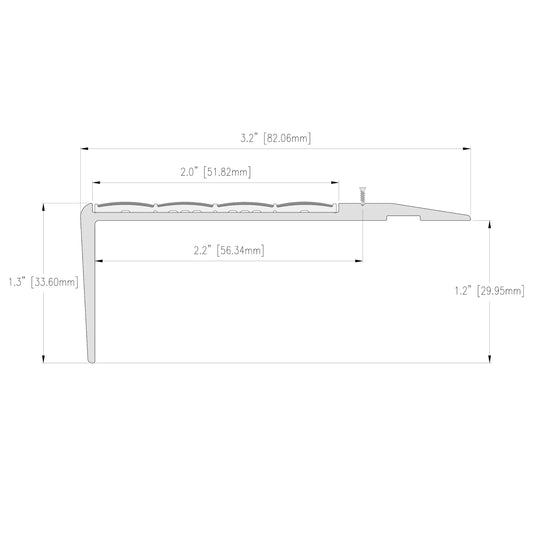
A full stair nosing uses an aluminum profile that covers or
integrates with the leading stair edge. A photoluminescent
contrast strip is a lower-profile step-edge marking installed
on the tread surface. The correct format depends on the stair
construction, desired edge coverage and project specification.
Which Ecoglo® photoluminescent product is suitable for tiled stairs?
Ecoglo® M4 Series tile nosings are designed specifically for
tiled stair assemblies. The
M4171.10 M4.10-E30
profile is intended for tile approximately 3/16 inch to 11/32 inch thick.
M4.125 profiles are available for thicker tile approximately 3/8 inch to 1/2 inch.
Which luminous stair nosing is designed for carpeted stairs?
The
Ecoglo® C4171 C4-E20
is a photoluminescent carpet stair nosing specifically shaped
for the leading edge of carpeted stairs. It combines protected
luminous markings with a hard-wearing non-slip insert.
C4171 Photoluminescent Carpet Stair Nosing | C4-E20
View C4171 →
Which Ecoglo® photoluminescent nosing is used for new concrete stairs?
The
S4071 S4-E30
is a photoluminescent cast-in-place stair nosing designed for
installation directly into wet concrete. Cast-in-place profiles
create a flush transition between the nosing and concrete stair surface.
S4071 Photoluminescent Cast-In-Place Nosing | S4-E30
View S4071 →
Are low-profile photoluminescent step edge markings available?
Yes. Ecoglo® E-Series photoluminescent contrast strips provide
a low-profile alternative to a full stair nosing. For example,
the
E4071 E40 Series
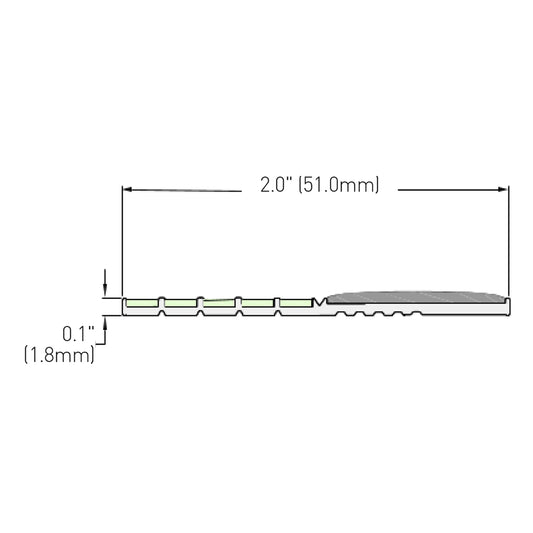
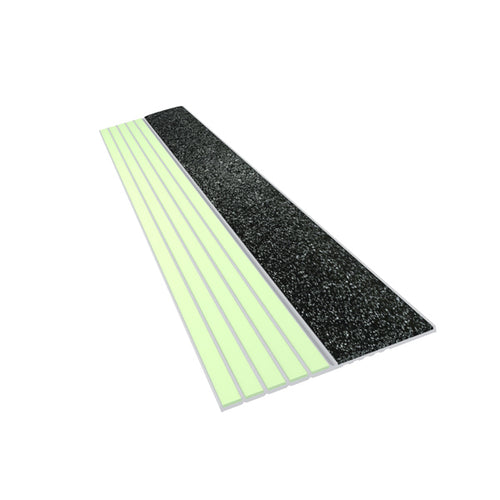
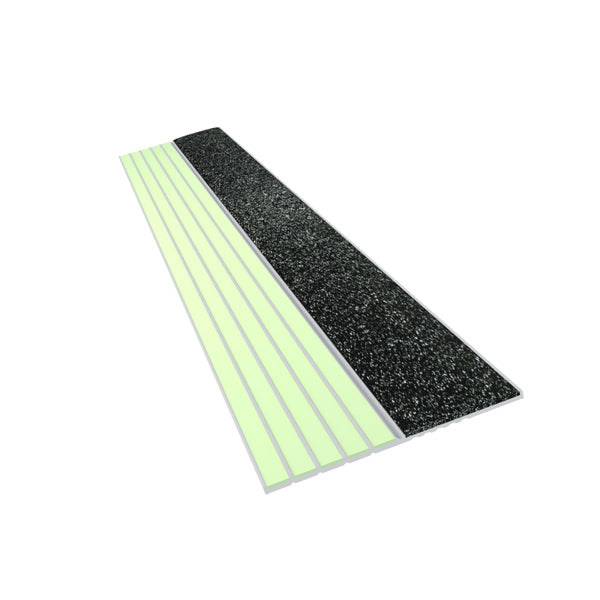
is a 2-inch-wide luminous step-edge contrast strip combining
photoluminescent marking with a black silicon-carbide non-slip surface.
E4071 Photoluminescent Contrast Strip | E40 Series
View E4071 →
Which photoluminescent stair nosings are designed for resilient or vinyl flooring?
Ecoglo® RF7B and RF7C Series resilient-flooring stair nosings
are designed to integrate flush with resilient flooring, vinyl
flooring and other thin floor finishes. RF7B uses a 90-degree
profile while RF7C uses an 85-degree profile, with E30 and E40
luminous configurations available.
Do photoluminescent stair nosings require electricity or batteries?
No electrical connection is required at the stair nosing.
Photoluminescent material absorbs energy from suitable natural
or artificial ambient light and releases that stored energy as
visible light when surrounding illumination falls.
Can Ecoglo® photoluminescent stair nosings be used outdoors?
Many Ecoglo® photoluminescent stair-nosing and contrast-strip
products are designed and tested for indoor and outdoor applications.
Outdoor suitability, fastening method, adhesive selection and
environmental exposure should always be confirmed for the exact
model and project before installation.
Are Ecoglo® stair nosings the same as glow-in-the-dark stair tape?
No. Ecoglo® stair nosings and rigid contrast strips use
manufactured aluminum-based profiles with integrated or protected
photoluminescent and non-slip materials. Product construction,
profile geometry and installation vary by series, so they should
not be treated as equivalent to generic adhesive glow tape.
What stair surfaces can Ecoglo® photoluminescent nosings be used on?
Ecoglo® manufactures different stair-nosing families for concrete,
wood or timber, steel, checker plate, carpet, tile, resilient flooring,
vinyl flooring and other suitable stair finishes. Select the product
profile according to the actual stair construction and approved detail.
Are photoluminescent stair nosings used for luminous egress path markings?
Yes. Photoluminescent step-edge markings can form part of a
luminous egress path-marking system where required by the applicable
building or fire code. Exact applicability depends on the building,
jurisdiction, adopted code edition, project documents and exact
product listing. Confirm the proposed system with the project designer
and Authority Having Jurisdiction.